

Origin Stories
Exploring local histories, mātauranga and knowledge of the iwi of Raukawa
About this field trip
There is value in learning about our ancestors' pathways and the stories that come from their deeds and adventures in the past. This is how we discover where and who we come from and why we connect with certain places. Mātauranga and tikanga are embedded in the whenua, which hold the footsteps of tūpuna. Exploring local histories leads to a deeper appreciation for what those in our past experienced and an understanding of who we are and where we stand today.
On this field trip, we will visit some key places in the history of Raukawa and hear narratives from iwi relating to these important historical locations and the epic journeys of the iwi tūpuna.
Objective
To develop cultural awareness, historical understanding, and a stronger connection to the local environment.
Key learning
Learn aspects of history about Raukawa, including significant locations and related stories passed down by iwi.
Experience storytelling as a way of preserving and sharing history, learning how narratives from iwi provide insights into the past and influence the present.
Investigate the journeys and experiences of ancestors, understanding how this influences identity and belonging and how iwi relate to the land.
Explore mātauranga and tikanga embedded in the whenua, learning how these shape cultural practices and values.
Reflect on the personal and collective connections of ākonga to significant places, fostering respect for the histories and traditions tied to those locations.
Student-led inquiry
Empower ākonga to take charge of their learning journey. Encourage them to ask meaningful questions, explore resources, and embark on their own journey of the histories and traditions of people and places they relate to.
Curriculum alignment
This virtual field trip aligns with the New Zealand Curriculum refresh (2022). It covers a range of learning areas, predominantly Social Sciences and Aotearoa New Zealand Histories. Access guidance that supports teaching and learning to align with curriculum goals.
Educator guide
-
Achievement objectives
Students will:
understand how people remember and record the past in different ways
recognise the significance of Māori oral traditions, including pūrākau, whakataukī, and waiata, in preserving histories
understand how people’s experiences shape their identities and relationship to places
investigate past events, their causes and consequences, and how they shape communities and societies
understand the relationship between people and places, examining the ways in which tūpuna shaped and were shaped by the land.
Key learning outcomes
Students will:
Learn about the history of Raukawa, including significant locations and narratives passed down by iwi.
Experience storytelling as a means to preserve and share history, exploring how these narratives shape identity and contemporary relationships to the land.
Investigate the journeys of tūpuna, recognising their influence on identity and cultural belonging.
Develop an appreciation for different perspectives of history, particularly those of iwi and hapū.
Engage in learning to explore personal and collective connections to historical events and places.
Virtual field trip as a key learning experience
Pre-field trip activities:
Kōrero & whakapapa: Introduce ākonga to key concepts of whakapapa, tūpuna stories, and connection to whenua. Discuss their own family histories and connections to place. Encourage students to document their reflections and insights through journals or digital storytelling.
Discover more: Read and/or listen to the virtual field trip Discover more pages. Participate in group discussions related to this information and summarise key ideas. Record questions prompted from new learning.
Mapping and navigation: Explore maps of historical migration routes. Discuss how natural landmarks and kōrero were used for navigation.
Storytelling workshop: Learn about oral storytelling traditions and create short narratives about personal or local histories.
Virtual field trip experience:
Exploration of significant sites: Visit locations of historical importance through the Google Earth tour. Listen to iwi narratives and reflect on key themes.
Interactive discussions: Facilitate group discussions on the importance of these locations and the stories associated with them.
Formulate questions: Encourage students to ask questions about the places and people involved in these histories. Use these questions to take part in the field trip web conference.
Post-field trip activities:
Reflective journaling: Students write reflections on what they learned and how it connects to their own sense of identity.
Creative expression: Use art, drama, or music to depict key stories from the field trip.
Student-led projects: Students choose an aspect of their learning to research further and present their findings.
Community engagement: Connect with local iwi or elders to learn more about regional histories and deepen cultural understanding.
Place-based learning and local histories
Organise visits to local historical sites or invite iwi representatives to share kōrero with students.
Guide students in researching local pūrākau and how they relate to their own identities and communities.
Student-led projects
Encourage students to develop their own research questions about people, places, and traditions that interest them.
Support students in exploring oral histories, archival materials, and digital resources.
Provide opportunities for students to present their findings through creative formats such as visual art, storytelling, drama, or multimedia presentations.
-
Explore the natural features of significant historical locations and understand how they influenced human settlement and migration.
Investigate the role of the environment in shaping the journeys of tūpuna.
Understand how ancestral knowledge of the land and natural resources influenced survival and settlement patterns.
-
Develop skills in reading and interpreting oral, written, and visual texts to understand historical narratives.
Create and share historical narratives using various formats (written, spoken, or digital storytelling).
Engage in discussion, listening to and respecting different perspectives on historical events and identities.
-
Explore traditional Māori visual and performing arts related to origin stories.
Use drama and visual arts to retell and represent historical narratives.
Engage in traditional Māori storytelling techniques such as waiata, haka, and carving to express historical knowledge.
-
Explore personal identity and belonging through connections to place and ancestry.
Engage in discussions about wellbeing and resilience through understanding historical journeys and challenges faced by ancestors.
Strengthen social connections by sharing and reflecting on personal and collective histories.
This curriculum guide is designed to support teachers in delivering an integrated learning experience utilising the Origin stories virtual field trip as a key learning experience.
This guide incorporates achievement objectives from multiple learning areas related to the New Zealand Curriculum. This provides a holistic approach to understanding the pathways of ancestors and the significance of their journeys and stories. The goal is to foster historical understanding, cultural awareness, and a strong connection to place and identity.
Learning areas and achievement objectives
Assessment and reflection
Formative assessment: Ongoing discussions, student reflection journals, and observation of engagement with their learning and the virtual field trip.
Summative assessment: Student projects, presentations, written narratives or creative storytelling pieces, and written reflections demonstrating understanding of key themes, local histories and cultural perspectives.
Self and peer assessment: Encourage students to reflect on their learning journey, share any completed work such as projects, and offer feedback to each other.

This trip reflects the United Nations Sustainable Development Goals (SDGs), especially Goal 11: Sustainable Cities and Communities: 11.4 Strengthen efforts to protect and safeguard the world’s cultural and natural heritage.
Discover more
Select a topic or image link for background information, images, narrations, and kupu Māori | key words for each topic.
Before the field trip: learning about origin narratives
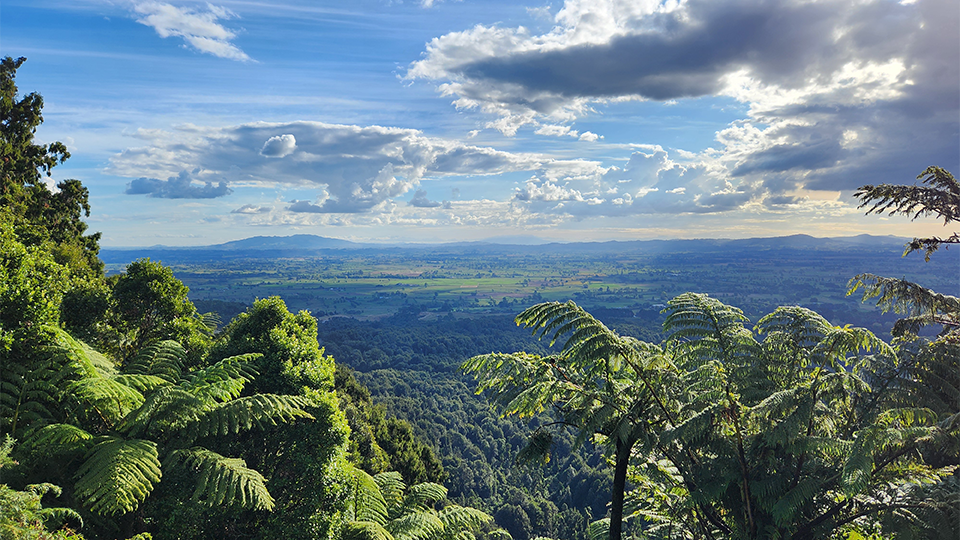
Once, a great chief named Tūrongo lived in Kāwhia on the West Coast of the North Island. Tūrongo came from a powerful family of the Tainui waka. But life wasn’t always easy, especially because he had a clever but competitive brother named Whatihua. The two brothers often clashed.
The scent of Raukawa: a love story that shaped an iwi
Have you ever wondered where your ancestors came from, or why certain places feel special to your whānau?
Connect with field trip experts
Insights into people and their careers.
Taihakoa Maui | Ngāti Wairangi will share his mātauranga on the Origin stories virtual field trip. In this video, he shares his pepeha.
Pepeha – Quinton Tunoho | Raukawa ki Wharepuhūnga
Quinton Tunoho | Raukawa ki Wharepuhūnga introduces himself with his pepeha. Quinton will share his knowledge of Māhina-a-rangi and her journey on the virtual field trip
Explore the field trip videos
Videos and more showcasing places, people, ideas and initiatives on this field trip.
Māhina-a-rangi and Tūrongo: A love story
Quinton recounts the narrative of the love story between Tūrongo and Māhina-a-rangi, the birth of Raukawa, and the journey undertaken by Māhina-a-rangi to her new home.
The pathways of our ancestors
Taihakoa welcomes us to the field trip and discusses what it means for him to share this mātauranga with others.
• What does Taihakoa refer to as "a blessing"?
• What does Taihakoa try to extract from the narratives?
• How do these narratives help Taihakoa develop a sense of connection?
Te Rere i Ōturu: Māhina-a-rangi farewells her people and her land
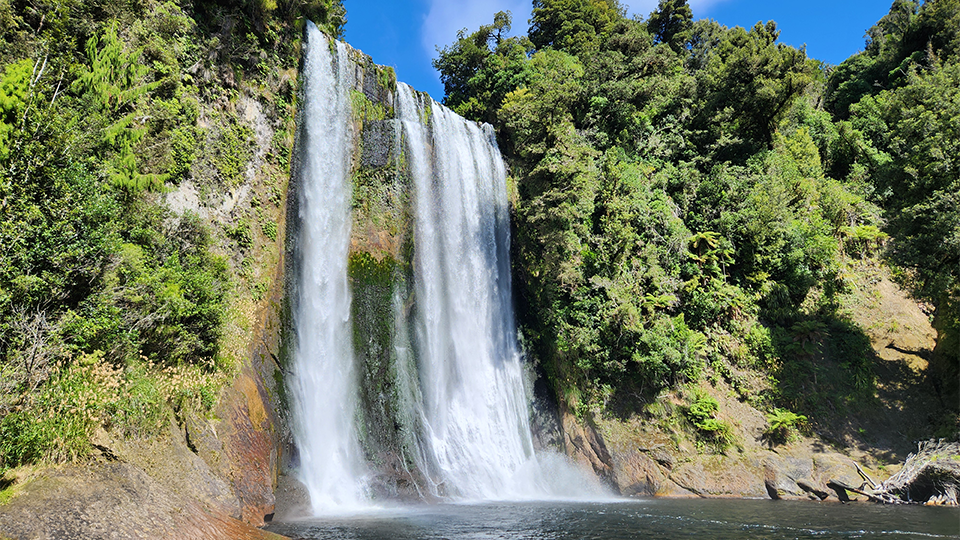
Nestled deep within the Kaimai Mamaku Forest Park, the Opuiaki Awa does not hold back. It flows to an edge and freefalls 40 metres to the rocks below, creating the waterfall known as Te Rere i Ōturu. It is here that Māhina-a-rangi looked back to farewell her people and lands.
• Which waka (canoe) do Māhina-a-rangi's people, Ngāti Kahungunu, trace their lineage back to?
• Who was Māhina-a-rangi's tūpuna who travelled through this way before her?
• Why is Te Rere i Ōturu such a significant place?
Whenua-ā-kura: The birthplace of Raukawa
Māhina-a-rangi and her people had a long journey across the land, made even more difficult due to Māhina-a-rangi being pregnant. As they crossed the Kaimai Ranges, Māhina-a-rangi went into labour. She gave birth to a baby boy at a place called Whenua-a-kura.
• What is a puna?
• What happened at Katikati?
Te Awa-a-Taikehu: Māhina-a-rangi crosses the Waikato River
After recovering from giving birth, Māhina-a-rangi continued the journey and finally reached the Waikato River. Once they had crossed the awa, a dog that Tūrongo had given Māhina-a-rangi, named Waitete, ran ahead to find him. When Tūrongo saw Waitete, he knew his wife and baby were close.
• What is Te Awa-a-Taikehu an original name for?
• What did Māhina-a-rangi do once she had crossed the awa?
Rangiātea: Māhina-a-rangi and Raukawa arrive at their new home
The end point in Māhia-a-rangi's journey and the place of her new home and people was Rangiātea. Here, in a sacred ceremony called a tohi, their baby was given the name Raukawa, after the fragrant oil that Māhina-a-rangi had worn during her secret meetings with Tūrongo. The scent of love, connection, and heritage.
• What is the video location known for once being?
• Discuss what activities might have taken place with the arrival of Māhina-a-rangi, her baby and entourage at Rangiātea.
• What thoughts do you have about origin narratives now that we have come to the end of the hīkoi?
Take the Google Earth tour
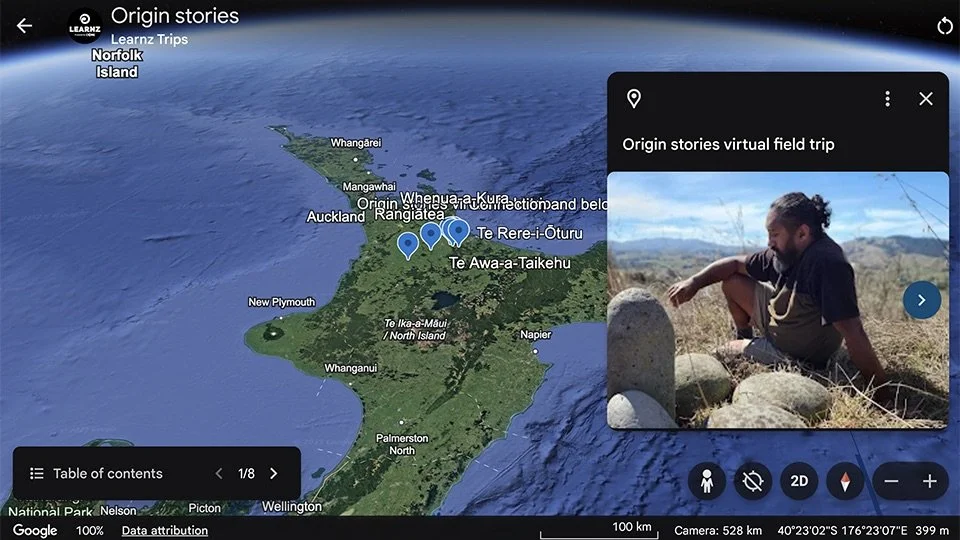
Take the Google Earth for Web Tour
A virtual tour of the field trip with GIS mapping, 3D locations, 360° panoramic images, videos, and further information.
Web conference
Replay the field trip web conference
We invited guest expert Pare from the iwi of Raukawa, to share her knowledge and thoughts around the field trip theme. Listen to the kōrero for further insights regarding the impacts and applications of historical narratives and mātauranga.
Resources and links
Māori history resource for teachers, providing a framework to support teachers to teach Māori history with their students.
Māori history - suggested topics and resources
From Tāhūrangi - New Zealand Curriculum, this resource helps educators engage with the question "What is Māori history and why should it be taught?”. There are suggested topics, resources, and ready-made teacher support materials.Tūhura: Where we came from – Aotearoa NZ's Histories
This Tūhura collection explores the context of Whakapapa me te Whanaungatanga through the theme of where we came from.Who are our ancestors and what are their stories?
From Te Papa Tongarewa. A series of activities with curriculum links, exploring ancestral stories to understand relationships to te taiao across places and times.New Zealand Gazetteer
Search for place names in New Zealand, its continental shelf, and Antarctica. This resource provides detailed information about the names, their locations, and other relevant data.New Zealand Geographic Features
Search for images and descriptions of New Zealand’s geographical features. This resource allows you to explore the diverse landscapes, such as mountains, rivers, lakes, and more, providing visual and descriptive information.Place name maps and publications
Maps and publications about New Zealand place names created by the New Zealand Geographic Board. These resources provide valuable information about traditional and current place naming practices in New Zealand.Oral History Atlas
A collection of oral histories that revolve around New Zealand's place names. These firsthand accounts and stories offer a unique perspective on the cultural and historical significance of various place names.Interactive map of Māori place names
Engage with an interactive map that highlights Māori place names throughout New Zealand. This resource allows for an interactive exploration of the Māori language and its connection to the naming of specific locations.
Raukawa specific
Pūrakau mapping
Mapping the narratives and stories of our landscape.Story: Ngāti Raukawa
Te Ara Encyclopedia of New Zealand