What are glaciers?
Glaciers are often called “rivers of ice.” Glaciers are giant, heavy masses of ice that move very slowly downhill.
Glaciers don't just appear overnight—they take hundreds or thousands of years to form. They start when heaps of snow falls in the same place and more snow gathers than melts year after year.
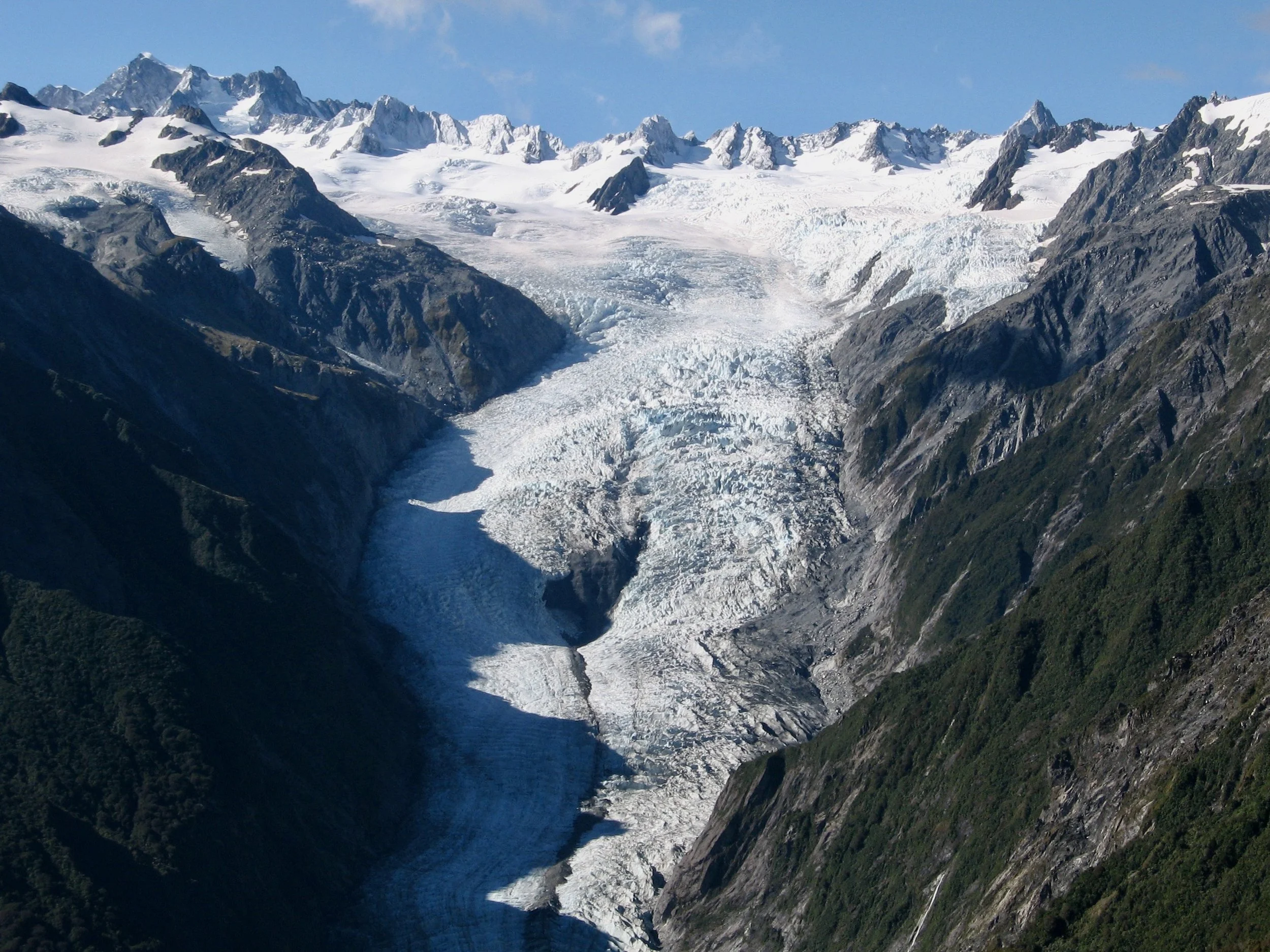
Kā Roimata o Hine Hukatere - Franz Josef Glacier. Image: LEARNZ.
Here is how snow turns into solid ice:
Fresh Snow: Fluffy snow falls on the ground.
The Big Squash: More snow falls on top. The weight of the new snow squashes the old snow underneath.
Snow Granules: The squashed snow turns into tiny, hard crumbs or granules.
Firn: The granules get packed even tighter into an icy sugar-like layer called firn.
Solid Ice: Finally, almost all the air is squeezed out, leaving a block of glacier ice.

Steps in the process of formation of glacial ice from snow, granules, and firn. Source: Steven Earle (2015) CC BY 4.0
Glacier ice has many trapped air bubbles and dust inside, but it is actually lighter (less dense) than liquid water by volume. That is why giant icebergs can float in lakes and in the ocean.
Types of glaciers
There are two main types of glaciers:
1. Mountain Glaciers (Alpine Glaciers)
These glaciers form high up on chilly mountainsides. As they slowly slide down into valleys, they act like giant bulldozers, pushing dirt, soil, rocks, and vegetation out of the way and making the valleys deeper and wider.
2. Ice Sheets
Ice sheets are like monster glaciers. Unlike alpine glaciers, they don’t just form in the mountains—they spread out in all directions like a giant puddle of pancake batter, burying everything in their path, including whole mountains and plains.
The biggest glaciers are called continental ice sheets.
Today, they cover almost all of Antarctica and Greenland.

Antarctic ice sheet - Victoria Land. Image: LEARNZ.
The Ice Age
Thousands of years ago, during a time called the Pleistocene Epoch, massive ice sheets repeatedly covered about one-third of the planet. Ice sheets recently reached their maximum size around 18,000 years ago. As these ancient glaciers spread, they carved out many of the lakes and hills we see today. Today, glaciers cover much less of the Earth—only about one-tenth, an estimated total area of about 700,000 square kilometres.
Where do glaciers form?
Glaciers need two things to survive: tons of winter snow and cool summers where temperatures remain below the freezing point of water so snow and ice don't melt away. Because they need the cold, you can find them at high latitudes near the North and South Poles, or high up on cold mountain peaks at lower latitudes. You can find glaciers on every continent on Earth—except for Australia.
Some tropical glaciers, like those in Indonesia, are rapidly being lost because of climate change. Mainland Australia and Tasmania used to have glaciers, but they no longer do.
How do glaciers move?
Even though a glacier looks like a solid, unmoving mass of ice, it actually creeps forward. Gravity pulls the heavy ice downhill.
Glaciers move in two ways:
1. Internal Flow (Internal Deformation): Deep inside the glacier, the weight from above is so heavy that the ice crystals actually change shape. Instead of snapping, the ice slowly bends and stretches like cold playdough, allowing the glacier to creep forward.
2. Slipping-and-Sliding (Basal Sliding): Down at the base of the glacier, all that heavy pressure and friction creates a thin layer of melting water. This water acts like a slippery playground slide, letting the whole giant mass of ice slowly advance right over the bedrock below.
Brittle versus plastic
A glacier acts differently depending on how deep you go:
The brittle or crunchy top: The top 50 metres of a glacier isn't under much pressure, so it is stiff and brittle. When the glacier moves, this top layer expands and contracts in places, creating scary, deep giant cracks called crevasses.
The plastic or slightly squishy bottom: Deep below the surface, the ice is packed tight and deforms smoothly like plastic.
The top of a glacier moves faster than the bottom. This is because the bottom of the glacier is constantly rubbing against rough rocks and dirt, which slows it down.

Erebus Ice Tongue, Antarctica. Image: LEARNZ.
How fast do glaciers travel?
Glaciers are the champions of slow racing. Some move only a few centimetres a year (slower than your fingernails grow). However, if a glacier is extra thick, sitting on a very steep mountain, or has a lot of water underneath it, it can zoom ahead by hundreds of metres in a single year.